Case Study: How a Real Estate Agency Grew Its AI Visibility From 13% to 37% in 4 Months
Sep 7, 2026 · 7 min read
Sep 7, 2026 · @Martech Team
A regional real estate agency was already showing up in 13% of AI answers about buying, selling and renting homes in its city. But it showed up as a place with listings, not as an expert anyone was told to call. Four months later it appears in 37% of answers, and AI tools have become one of its steadiest sources of seller leads.
| Snapshot | |
|---|---|
| Client | A residential real estate agency with 6 offices and about 40 agents in one metro region |
| Business | Home sales, rentals and property valuations; about 900 active listings |
| Prompts tracked | 56, across 5 AI models |
| Time frame | 4 months |
| Main result | Mentioned in 37% of AI answers, up from 13% |
The challenge: visible, but only as a listing
The agency's starting point was better than most. Its listings were syndicated to the big property portals, and the AI often pointed renters to those listings. That explained most of the 13%.
The problem was where the agency was missing. When someone asked "Who is the best agent to sell my apartment in [city]?", "Which neighborhood is best for families?" or "Is [city] a good place to invest in rental property?", the AI recommended other agencies, review platforms and city blogs. Those are the questions that lead to the most valuable business: seller mandates, valuations and investor clients.
The goal was to change the agency's role in AI answers: from a place where listings appear to a local expert the AI recommends.
Building the prompts around audiences
In real estate, the same city gets very different questions depending on who is asking. So instead of starting from topics, we started from people. Each agent wrote down the five questions they hear most often in a first meeting, and we grouped them by audience.
| Audience | Prompts | Example prompt |
|---|---|---|
| Buyers, mostly first-time | 14 | Which neighborhoods in [city] are best for a first apartment under [budget]? |
| Sellers | 12 | How do I choose an agent to sell my home in [city]? |
| Renters | 10 | How much does a 2-bedroom apartment cost to rent in [district]? |
| Investors | 8 | Which areas of [city] have the best rental yield? |
| People relocating to the city | 8 | Moving to [city] with kids: where should we live? |
| Brand | 4 | Is [agency] a good real estate agency? |
Two rules shaped the list. First, every prompt had to name a real place: the city, a district or a neighborhood, because that is how people ask about property. Second, we included the questions people ask before they need an agent, such as prices, neighborhoods and the buying process, because that is when they decide who to trust.
What the first analysis showed
After two weeks of runs, the 13% average hid a very uneven picture. The agency did well with renters, thanks to its portal listings. For sellers, investors and people relocating, it was close to invisible.
The Sources export explained why. Each audience was answered from a different set of websites:
| Audience | Main sources the AI used | What we found |
|---|---|---|
| Renters and buyers | Property portals | The agency's listings were there, but many lacked floor plans, energy ratings and the exact neighborhood name |
| Sellers | Agent review platforms and local business directories | Only 6 of 40 agents had a profile; one office still showed an old address and a 3.6 rating from before a management change |
| Buyers and relocating families | City blogs and a competitor's neighborhood guides | The competitor had a page for every neighborhood; the agency had none |
| Investors | Statistics office data, property news and market reports | The AI quoted price and rent figures, but none came from the agency |
| People relocating | Expat forums and relocation company websites | Not mentioned anywhere |
One pattern ran through all of it: the AI recommended agencies that published local knowledge, not just properties. The agency had 15 years of transaction data and agents who knew every street, but none of that was online in a form the AI could read.
The playbook: five plays in four months
Each play answered one gap from the analysis. The first two were quick fixes; the last three built something new.
Play 1: Complete listing data (month 1)
The agency updated its listing feed so every property sent to the portals carried a floor plan, energy rating, year of construction and the exact neighborhood name, not just the district. What happened: listings started appearing in more specific prompts, such as "2-bedroom with balcony in [neighborhood]".
Play 2: Agents people can find (month 1)
All 40 agents got verified profiles on the two review platforms the AI cited most, showing their neighborhoods and recent sales. The old office listing was corrected, and every closed sale now ends with a review request. What happened: 190 new reviews in 3 months, and the agency started appearing in "choose an agent" answers.
Play 3: A neighborhood hub (months 2 and 3)
The agency published a page for each of its 24 neighborhoods. Each page has the median price per square meter, average days on market, typical rents, schools, transport and a short local view from the agent who covers the area. The figures come from the agency's own sales and update every month. What happened: within 6 weeks, these became the agency's most cited pages, used in buyer and relocation answers.
Play 4: A quarterly market report (month 2)
Using its own transaction data, the agency released a short quarterly report on prices, rents and demand by district. It went to local news and property media with the head of sales available for comment. What happened: 9 articles cited the report, and the AI began quoting its figures in investor answers, naming the agency as the source.
Play 5: A welcome for newcomers (months 3 and 4)
The agency wrote an English-language relocation guide covering districts, schools, rental rules and costs, and ran two online sessions for the HR teams of large local employers. Two relocation companies added the guide to their resources, and agents answered questions in the city's main expat forum. What happened: the agency went from no mentions at all to being one of the names the AI suggests to families moving to the city.
Results after 4 months
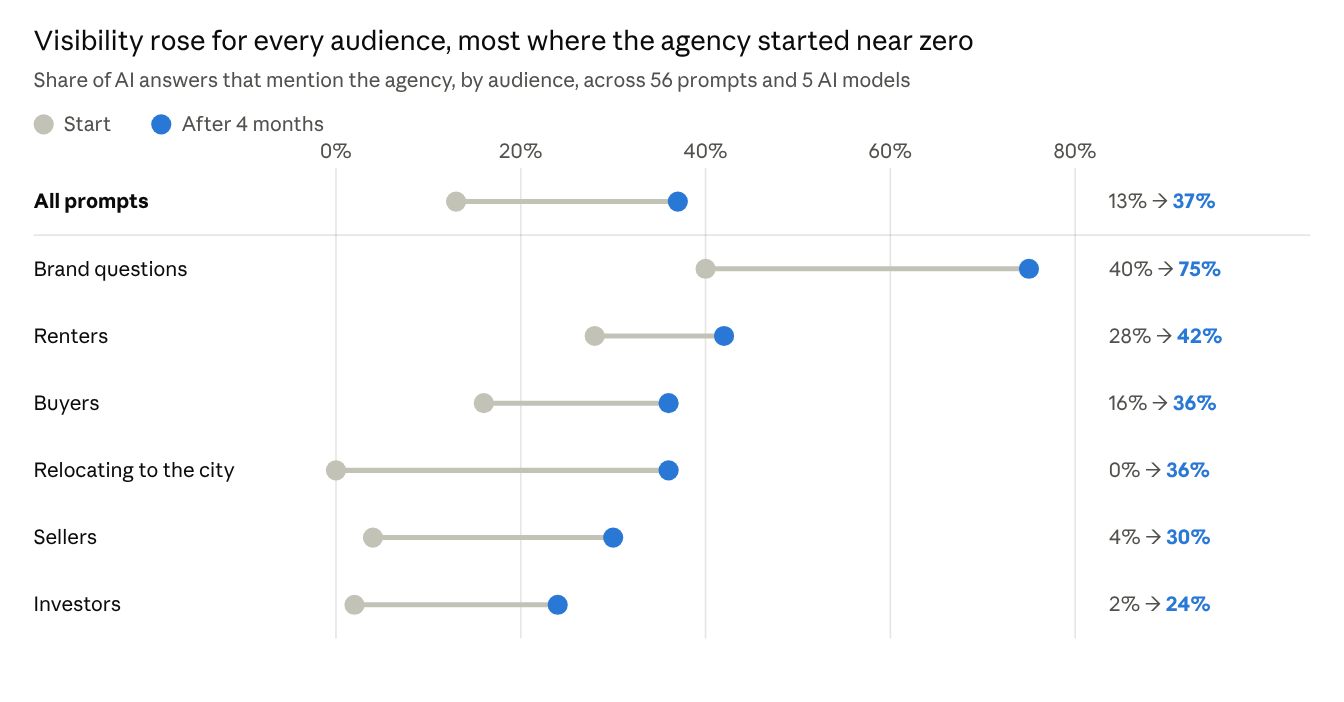
| Audience | Start | After 4 months |
|---|---|---|
| All prompts | 13% | 37% |
| Brand questions | 40% | 75% |
| Renters | 28% | 42% |
| Buyers | 16% | 36% |
| Relocating to the city | 0% | 36% |
| Sellers | 4% | 30% |
| Investors | 2% | 24% |
AnswerRank runs, 56 prompts across 5 AI models; start = first two weeks of runs.
The overall share climbed steadily, month by month: 13%, 18%, 24%, 31% and then 37%. The biggest change was not in the average but in its shape. Sellers, investors and people relocating, the audiences that were nearly invisible at the start, now make up most of the growth.
| Business result | Start | After 4 months |
|---|---|---|
| Citations of the agency's own website | 48 | 260 |
| Prompts where the agency's website is a source | 9 of 56 | 31 of 56 |
| Monthly website visits from AI tools | ~600 | ~1,900 |
| Monthly valuation requests from AI visits | 9 | 46 |
In the 4 months, leads that first arrived from AI tools turned into 14 new seller mandates. For an agency, a seller mandate is the most valuable lead there is, and it was exactly the audience that had been missing at the start.
Takeaways for real estate companies
Split your average by audience. A single visibility number can hide the fact that you are strong where the business is small and weak where it is big.
Every audience has its own sources. Renters are answered from portals, sellers from review platforms, investors from market data, newcomers from forums and relocation sites. Each needs its own play.
Your local knowledge is your best content. Neighborhood figures and agent insight are hard for anyone else to copy, and the AI rewards them.
Data you publish regularly keeps getting cited. A monthly-updated neighborhood page or a quarterly report gives the AI fresh numbers, with your name attached.
Make every agent findable. People choose a person, not only an agency. Profiles and reviews for each agent turned "choose an agent" questions from a gap into a strength.