Case Study: How an Online Language Courses App Grew AI Citations by 70% in 6 Months
Nov 12, 2026 · 7 min read
Nov 12, 2026 · @Martech Team
An online language courses app went from 410 to 697 monthly AI citations in six months, a 70% increase. AI assistants now name it in 41% of answers about learning a language online, up from 12%. None of this came from new ads or a bigger blog. It came from giving AI models the facts they needed to compare the app with bigger, better-known rivals.
At a glance
| Business | Online language courses app with live tutors and self-paced lessons |
| Languages | 9 languages taught, website and app in 5 interface languages |
| Learners | ~4,500 active learners, mostly in Europe |
| Prompts tracked | 60, in 3 languages, across 4 AI models |
| Time frame | 6 months |
| Headline result | +70% citations (410 → 697 per month) |
The client
The app teaches 9 languages through a mix of short self-paced lessons and 25-minute live sessions with certified tutors. Its learners are mostly adults: people moving abroad for work, students preparing for exams such as IELTS or DELE, and professionals who need a language for their job.
It had a loyal user base and a 4.7 app store rating. Its marketing team of three ran paid social, an email programme and a blog in English. AI visibility had never been measured.
The challenge: losing the comparison before it started
Language learning is one of the most crowded categories AI assistants answer about. When a learner asks which app to use, the AI usually lists three to five options with one line each. The two largest free apps took a place in almost every answer.
The client did appear sometimes, but in the wrong way. In the first month of tracking, AI answers described it as "a tutoring marketplace", quoted a price that was two years out of date, and in one model claimed it did not offer Spanish. When it was cited, the source was usually a third-party listicle, not its own website.
Three problems sat underneath:
- No comparable facts. Course pages said "learn faster" but never said how long a level takes, what it costs per month or which exam it prepares for. AI models compare on facts, so they skipped the app.
- English only. A third of learners searched in German, Spanish or Polish, but the site's useful content existed only in English.
- Outdated third-party pages. The most cited pages about the app were review articles written in 2023 and 2024.
Step 1: Track the questions learners actually ask
Learners rarely ask an AI for "a language app". They ask about a goal and a deadline. We pulled questions from support tickets, onboarding surveys and tutor notes, and turned them into 60 prompts. Each prompt was tracked in English, German and Spanish.
| Learner goal | Prompts | Example prompt |
|---|---|---|
| Exam preparation | 14 | Best online course to pass DELE B2 in 3 months |
| Moving abroad | 12 | How to learn German fast before relocating to Berlin |
| Speaking practice | 10 | Affordable app with live conversation practice in Italian |
| Work and business | 9 | Business English course with certificate for my CV |
| App comparisons | 9 | Language app with real tutors vs free apps, which is better? |
| Kids and teens | 6 | Online Spanish lessons for a 12-year-old |
Brand-name prompts were left out on purpose. The growth had to come from learners who did not yet know the app.
Step 2: Find where the AI gets its answers
After three weeks of runs, the sources export showed which pages AI models relied on for language-learning questions.
| Source type | Share of citations | What we found |
|---|---|---|
| "Best language apps" listicles | 31% | Client in 3 of 11 lists, all with old prices |
| Forums and Q&A communities | 21% | Learners praised the tutors, but threads were 2+ years old |
| Brand websites (all apps) | 19% | Client's pages cited only 6 times; no clear facts to quote |
| Video platforms (via transcripts) | 12% | No client videos with spoken comparisons or level guides |
| Exam boards and education sites | 11% | Official exam pages linked to rivals' prep courses, not the client |
| App store listings | 6% | Description focused on design, not on levels, tutors or exams |
The lesson: the AI was not ignoring the app. It just could not find a recent, factual page to quote when comparing it.
Step 3: Fix, publish and earn
The work ran in three overlapping phases. The marketing team did most of it, with tutors writing the expert content.
Months 1 and 2: make the facts quotable
- One fact sheet per course. Every course page now opens with the same short block: level range (A1 to C1), hours per level, live sessions per month, price per month and which exams it prepares for.
- Updated pricing everywhere. Prices and plans were corrected on the site, app store listings and 22 partner and review pages that the team could edit or request changes to.
- Structured data. Course, FAQ and review markup was added so models and search engines read the same facts.
Months 3 and 4: content AI models can compare
- Honest comparison pages. Six pages compare the app with free apps and tutor marketplaces, including where the alternatives are the better choice. These became the most cited pages on the site.
- "How long does it take" guides. Tutors wrote guides per language and level, such as hours from A2 to B1 in German, based on the app's own anonymised learner data.
- Five interface languages. The fact sheets, comparison pages and guides were translated and adapted into German, Spanish, French and Polish, not machine-translated word for word.
Months 5 and 6: earn new third-party sources
- Original data. A short report on 4,000 learners showed how often learners study and which habits predict passing an exam. Two education outlets and 9 language blogs cited it.
- Listicle refresh. The team sent updated facts and a test account to the authors of the 11 most cited listicles. Seven updated their articles; four added the app for the first time.
- Tutor voices in communities. Tutors answered learner questions in forums under their own names, with clear disclosure. They gave advice first and mentioned the app only where relevant.
- Short video explainers. Twelve videos with spoken level guides gave transcript-reading models new material to cite.
Results after 6 months
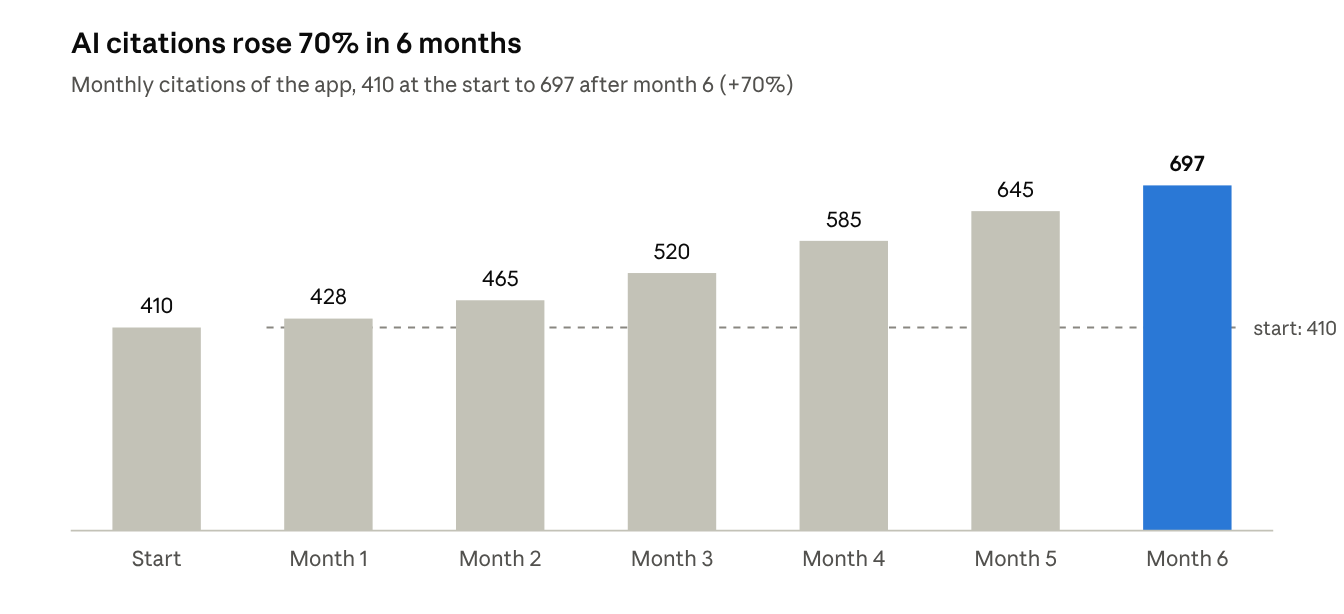
| Period | Monthly citations |
|---|---|
| Start | 410 |
| Month 1 | 428 |
| Month 2 | 465 |
| Month 3 | 520 |
| Month 4 | 585 |
| Month 5 | 645 |
| Month 6 | 697 |
AnswerRank runs · 60 prompts in 3 languages across 4 AI models · monthly totals
Months 1 and 2 fixed what the AI already had wrong, so growth was small. The jump came in months 3 and 4, when comparison pages and level guides gave models facts to quote. Months 5 and 6 added new third-party sources from the learner data report and refreshed listicles.
| Result | Start | After 6 months |
|---|---|---|
| Share of AI answers that name the app | 12% | 41% |
| Prompts where the app is mentioned at least once | 11 of 60 | 34 of 60 |
| Citations of the app's own website per month | 6 | 148 |
| AI models that recommend the app | 2 of 4 | 4 of 4 |
| Non-English prompts that mention the app | 3 of 40 | 22 of 40 |
| Monthly trial sign-ups from AI tools | ~90 | ~610 |
Sign-ups from AI tools were measured through referral data and a "How did you hear about us?" question at sign-up. Learners who came from an AI answer converted to paid plans at a higher rate than paid-social sign-ups, because they arrived already comparing on price and level.
Takeaways for edtech and language apps
Give the AI numbers to compare. Hours per level, price per month and exam coverage are what models quote. Marketing claims are not.
Track in the languages your learners use. Prompts in German and Spanish produced different sources and different rivals than English ones.
Be honest in comparisons. Pages that admitted when a free app was the better fit were cited far more than pages that only praised the product.
Your own data is a source. Anonymised learner statistics turned into a report that others cited, and the AI followed.
Old reviews keep talking. Refreshing the listicles the AI already trusted was faster than waiting for new ones to rank.
In the client's words
*"We thought AI assistants simply preferred the big free apps. It turned out they just didn't know our facts. Once our prices, levels and exam results were easy to find and compare, we started showing up next to the names everyone knows."*
— *Head of Marketing, online language courses app*