Case Study: How a Local Shoe Store Went From 2% to 34% in AI Answers
Nov 6, 2026 · 6 min read
Nov 6, 2026 · @Martech Team
A family-owned shoe store with two shops in one city appeared in just 2% of AI answers about buying shoes locally. Five months later it appears in 34%. The easiest way to see the change is to ask an AI the same question then and now.
The question: "Where can I buy comfortable wide-fit shoes in [city]?"
Answer at the start: the AI suggested two national shoe chains and a large online retailer, and advised the user to "check local stores". The family store was not named.
Answer after 5 months: the AI named the family store first, mentioned its free foot measuring and wide-fit range, and gave the address of the shop in the old town.
The store at a glance
| Business | Family-owned shoe store, open for 38 years |
| Locations | 2 shops in one city, plus a small online shop |
| Known for | Wide-fit and comfort shoes, children's shoes with foot measuring, running shoes, shoe repair |
| Prompts tracked | 40, across 4 AI models |
| Time frame | 5 months |
Why a local store is easy to miss
The owners knew their customers loved the shop. Reviews were good and many customers had been coming for years. But when a new person asked an AI where to buy shoes in the city, the answer was built from national chains, big online shops and generic advice.
For a local store, the AI's picture comes from a few specific places: map and business listings, "best shops in [city]" guides, review sites and local news. If those places describe the store poorly, or not at all, the AI has nothing to recommend.
Prompts built around needs, not products
People rarely ask an AI for "a shoe store". They ask about a problem or an occasion: sore feet, a wedding, a child's first school shoes. So the staff spent one week writing down every question customers asked at the till, and we turned them into 40 prompts. Every prompt included the city or a district name.
| Need | Prompts | Example prompt |
|---|---|---|
| Foot problems and comfort | 12 | Where can I buy shoes for flat feet in [city]? |
| Occasions | 8 | Where to buy comfortable wedding shoes in [city] |
| Children | 6 | Where can I get my child's feet measured in [city]? |
| Running and walking | 6 | Running shoe store with gait analysis in [city] |
| "Near me" shopping | 6 | Good shoe shops in [district] open on Saturday |
| Repair and care | 2 | Who repairs shoe soles in [city]? |
We did not add any brand prompts. Almost nobody outside the city knew the store's name, so the only questions that mattered were the ones that didn't include it.
What the sources showed
After the first three weeks of runs, the Sources export showed where the AI looked for local shoe shops:
| Source type | Share of citations | What we found about the store |
|---|---|---|
| Map and business listings | 34% | Listed as "Shoe store" only; no mention of wide fit, foot measuring or repair; Sunday hours wrong |
| City guides and local blogs | 22% | Not in any of the 4 "best shoe shops in [city]" articles the AI used |
| Review sites | 18% | Good ratings, but reviews rarely said what customers bought or why they came |
| National chains and online shops | 10% | Where the AI sent people when it found no local answer |
| Local news | 10% | One article about the store from 6 years ago |
| Community sites, such as running clubs and city forums | 6% | Mentioned in a few forum posts, always positively, but never linked |
The main lesson was simple. The AI did know the store existed, but it didn't know what the store was good at. A listing that says "shoe store" cannot answer "where can I buy shoes for flat feet?", so the AI picked a chain instead.
What the store did
The store has no marketing team. Everything below was done by the owners, two staff members and a few hours a week of outside help.
Quick wins (month 1)
- Rewrote the map and business listings. Both shops now list their real specialities: wide-fit shoes, children's foot measuring, running gait analysis and shoe repair. Opening hours were corrected, and 30 new photos show the shelves, the measuring corner and the repair bench.
- Made the same facts match everywhere. Name, address, hours and services were made identical across 14 local directories, so no source contradicted another.
- Showed what is in stock. The online shop started showing which shoes are available in each shop today. The AI began using this for questions like "where can I buy [model] in [city] today?".
Content from the shop floor (months 2 and 3)
- One page per specialty. Short, practical pages for wide fit, flat feet, children's measuring, running shoes and repairs, each with prices, how long it takes and which shop offers it.
- Reviews that say something. Instead of "please leave a review", staff asked customers to mention what they came in for. Within three months, 120 new reviews described specific needs, such as wide fit, school shoes and repairs.
Local partners (months 3 to 5)
- The running club. The store started fitting shoes for the city's biggest running club. The club's website now lists it as its recommended shop.
- Schools. Four primary schools added the store's free foot measuring day to their parent newsletters and websites.
- A local story. A 38-year-old family shop that still measures every child's feet by hand was a good story. Two local news sites and three city guides covered it, and each article was later used by the AI.
Results after 5 months
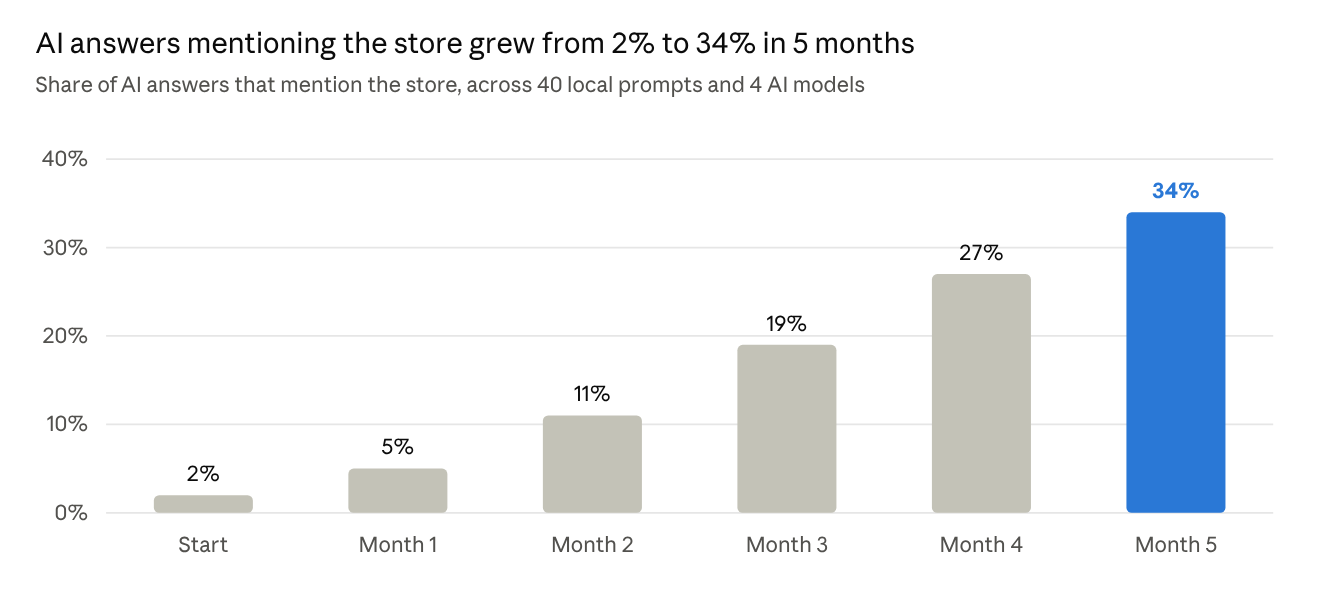
| Period | Percentage |
|---|---|
| Start | 2% |
| Month 1 | 5% |
| Month 2 | 11% |
| Month 3 | 19% |
| Month 4 | 27% |
| Month 5 | 34% |
AnswerRank runs, 40 prompts across 4 AI models, monthly average.
The quick wins in month 1 moved the needle a little. The real growth started in month 2, when the speciality pages and specific reviews gave the AI clear reasons to recommend the store, and it kept going as local partners and press added more trusted sources.
| Result | Start | After 5 months |
|---|---|---|
| Prompts where the store is mentioned at least once | 1 of 40 | 21 of 40 |
| AI models that mention the store | 1 of 4 | 4 of 4 |
| Citations of the store's own website | 0 | 74 |
| Monthly website visits from AI tools | ~10 | ~420 |
| Customers per week who say an AI recommended the store | 0 | ~30 |
The last number comes from the simplest tracking method there is: staff ask every new customer how they found the shop. By month 5, about 30 people a week answered "ChatGPT told me" or something similar.
Takeaways for local stores
Tell the AI what you are good at. Being listed is not enough. Your listings, pages and reviews should name the specific problems you solve.
Write prompts from the till. The best prompts came from questions customers ask in the shop, always with the city or district name.
Get the basics identical everywhere. Matching names, hours and services across directories cost nothing and removed confusion.
Local partners are local sources. A running club, schools and city guides are exactly the websites the AI reads for local questions.
You don't need a big team. Most of the work was done by the owners in a few hours a week, using what they already knew about their customers.