Case Study: A New Hair Removal Brand's 6-Month Path Into AI Answers
Oct 17, 2026 · 8 min read
Six months after its first AnswerRank run, a hair removal brand that launched less than a year ago appears in 24% of AI answers about at-home hair removal, up from 2%. AI tools now send it about 740 visits and 32 orders a month.
| At a glance | |
|---|---|
| Client | A new brand of at-home IPL hair removal devices, sold online in one country |
| Starting point | Launched 9 months earlier, no press coverage, one marketplace listing |
| Prompts tracked | 48, across 5 AI models |
| Time frame | 6 months (26 weeks) |
| Main result | Mentioned in 24% of AI answers, up from 2% |
The moment the team noticed
It started with a customer email. A woman wrote that she almost didn't buy the device, because an AI chatbot had told her it was "not suitable for darker skin tones". That was not true: the device has a skin tone sensor and works on a much wider range of skin tones than the warning suggested.
The founders typed the same question into a few AI tools. Some gave the same warning. Others didn't mention the brand at all and recommended three established competitors instead. The team realised that a growing part of their customers' research was happening in a place they couldn't see. They started with AnswerRank to see it.
Chapter 1: Asking the right questions
The prompt list was built in two rounds, and the second round mattered more than the first.
Round 1, week 0. The team wrote 40 prompts from customer emails, questions under competitors' marketplace listings, and forum threads. Most were what a first-time buyer would ask: "Does IPL hurt?", "How long until I see results?", "Which IPL is best?".
Round 2, week 2. After the first two weeks of runs, two problems showed up:
- 6 prompts only produced general explanations with no products named, such as "What is IPL?". They told us little about the brand, so we removed them.
- Whole groups of buyers were missing. We added 14 prompts for men, for face and bikini use, for people with darker skin tones, and for budget buyers comparing cheap and premium devices.
The final list had 48 prompts:
| Intent | Prompts | Example prompt |
|---|---|---|
| How it works | 12 | How many sessions does at-home IPL need? |
| Best device | 10 | Best IPL for face and bikini line |
| Safety and skin tone | 8 | Can I use IPL on medium-dark skin? |
| Comparison | 8 | At-home IPL vs salon laser: cost and results |
| Where to buy | 6 | IPL device with a 90-day money-back guarantee |
| Price | 3 | Is a budget IPL device worth buying? |
| Brand | 1 | Is [brand] IPL safe? |
Chapter 2: What the AI was really saying
By week 4, the full list of 48 prompts had run for two weeks across 5 AI models. The brand appeared in 2% of answers, and its own website had not been cited once. The team exported the Sources report and went through the top 25 websites one by one. They made three discoveries.
Discovery 1: the wrong warning had a source. In 3 of the 8 safety prompts, the AI said the device was not suitable for darker skin. Every one of those answers cited the same two retailer pages. Both still showed a spec sheet from before launch, written for an early prototype without the skin tone sensor.
Discovery 2: the AI wanted proof, not promises. Answers to "does IPL work?" quoted percentages, study results and cost comparisons. The established brands had clinical data; the new brand only had product claims. A claim gives the AI nothing to quote.
Discovery 3: not every door was closed. The "best IPL" lists in magazines looked hard to enter. But price and comparison prompts relied on different websites: deal sites, comparison tables and marketplace Q&A sections. Here, a new brand could compete right away. The marketplace listing alone had 41 customer questions with no answer.
| Where the citations came from | Share of citations in the top 25 |
|---|---|
| Beauty and lifestyle magazines | 31% |
| Retailers and marketplaces, including Q&A sections | 24% |
| Comparison and deal sites | 17% |
| Forums and podcast transcripts | 15% |
| Medical and dermatology sites | 9% |
| Competitor brand websites | 4% |
Chapter 3: Fix, prove, expand
The three discoveries turned into three phases. They overlapped, because some work, like a user trial, takes months to finish.
Phase 1: Fix (weeks 4 to 8)
The first goal was to stop the AI from repeating something false.
- The team contacted both retailers and had the outdated spec pages replaced within 3 weeks.
- They published one public spec sheet on their own site, with the skin tone range, energy levels and safety features. Any retailer, journalist or AI now had one correct page to rely on.
- They answered all 41 open questions in the marketplace Q&A, in plain language and with exact numbers.
Phase 2: Prove (weeks 8 to 20)
The second goal was to give the AI numbers it could quote.
- A user trial. 45 people used the device for 10 weeks. The results, and how they were measured, were published on a dedicated page.
- A cost calculator. A free tool comparing at-home IPL, waxing and salon laser over 3 years.
- A survey. 1,500 adults were asked how much time and money they spend on hair removal. The findings went to journalists as a press release, and 6 lifestyle sites wrote about them, naming the brand as the source.
Phase 3: Expand (weeks 16 to 26)
The third goal was to enter the sources behind price and comparison answers, then reach the bigger ones.
- Listed on 2 deal sites and added to the comparison tables of 3 review sites through their partner programs.
- The product engineer hosted a live Q&A in the largest hair removal forum and answered 120 questions in one evening.
- Guest spots on 3 beauty and wellness podcasts, each with a published transcript.
- An aftercare bundle with an established skincare brand, featured on the partner's website.
- Product structured data added to every product page, so product facts were easy for machines to read.
Chapter 4: The results
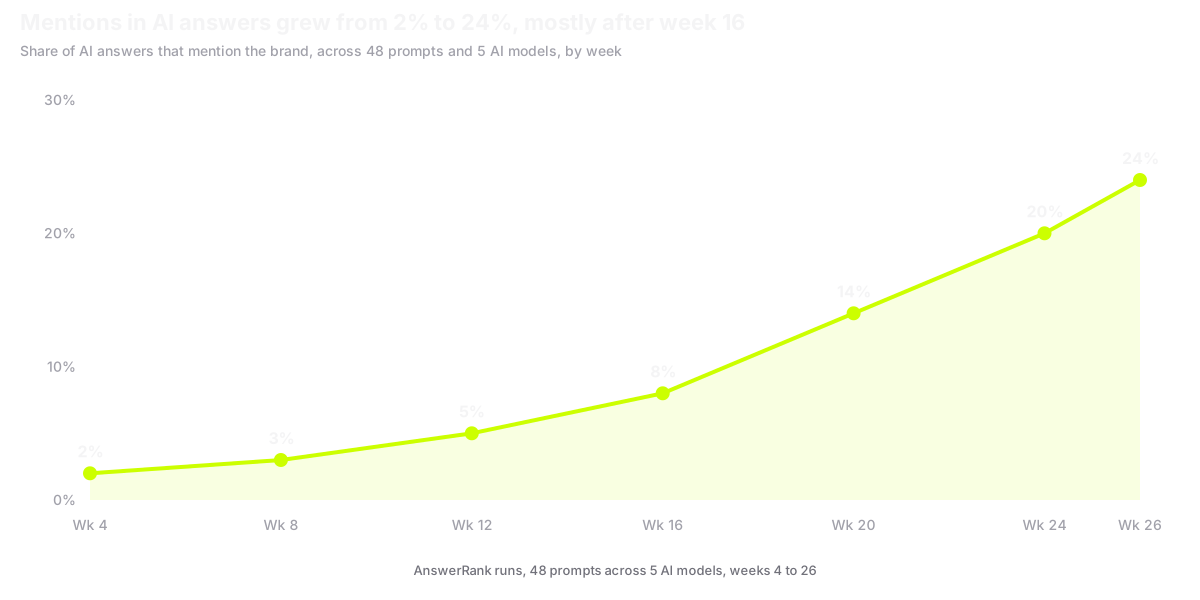
For the first 12 weeks, the line barely moved, and the team wondered if the work was paying off. Then the trial results, the survey coverage and the comparison tables all reached the AI within a few weeks of each other, and visibility tripled between weeks 16 and 26.
| Measure | Week 4 | Week 26 |
|---|---|---|
| Safety prompts where the AI warned against the device | 3 of 8 | 0 of 8 |
| Citations of the brand's own website | 0 | 112 |
| Prompts where the brand's website is a source | 0 of 48 | 18 of 48 |
| AI models citing the brand's website | 0 of 5 | 4 of 5 |
| "Best device" prompts mentioning the brand | 0 of 10 | 3 of 10 |
| Monthly website visits from AI tools | ~25 | ~740 |
| Monthly orders from AI visits | 1 | 32 |
In these 6 months, about 155 customers bought after first arriving from an AI tool. The brand's most-cited page today is not a product page but the user trial results.
Lessons from the team
> "We thought our problem was being invisible. Our first problem was being described wrongly."
Read the sentences, not just the scores. The most damaging finding was a single false warning, and it only showed up when the team read the answers and the pages behind them.
Revise your prompts after the first run. The second round of prompts uncovered buyer groups the brand had never thought to check.
Proof travels further than claims. The trial, the survey and the calculator kept earning citations months after they were published.
Start where the door is open. Deal sites, comparison tables and Q&A sections let a young brand compete before the big magazines are ready to include it.
Give it time. Most of the growth came after week 16, when the slow work of Phase 2 finally reached the AI.