From Invisible to Recommended: How a Farm Machinery Retailer Won AI Search in 5 Months
Aug 26, 2026 · 9 min read
In 5 months, a heavy agricultural machinery retailer went from appearing in 4% of AI answers about farm machinery to 31%. Monthly visits from AI tools grew from about 90 to 1,450, and those visits turned into 41 quote requests a month. This is the full path: the prompts, the first sources analysis, every action taken, and the results.
The client and the challenge
The client is a retailer of heavy agricultural machinery: tractors, combine harvesters, balers, sprayers and tillage equipment. It sells new and used machines from several manufacturers, offers financing, and runs its own service workshops. Its website lists about 1,200 machines.
The sales team noticed a change. More farmers arrived already knowing which model they wanted, and some said they had "asked ChatGPT". When the team tried the same questions, the AI recommended marketplaces, manufacturers and two competing dealers. The retailer was almost never mentioned.
The goal was simple: when a farmer asks an AI where to buy, what to buy, or how to choose a machine, the retailer should be in the answer.
Step 1: Choosing and optimizing the prompt list
We started with what farmers really ask, not what the client wanted to rank for. The sales team, the service desk and the website's search logs gave us 120 raw questions.
We wrote for two audiences, not only the existing customers. The first was experienced, professional farmers who already know their machines. The second was people new to farming: young farmers taking over a family farm, career changers and small hobby farms. New farmers ask simpler questions, such as "what equipment do I need to start a 50-hectare farm?" or "is a used tractor a good first purchase?", and they have no favourite dealer yet. About a third of the prompts were written from their point of view.
We then cut and balanced the list to 72 prompts:
- Removed duplicates. Many questions asked the same thing in different words.
- Grouped by intent. Each prompt was tagged by what the farmer was trying to do, so we could see later where the client was strong or weak.
- Kept brand prompts small. Only 6 of 72 prompts name the brand. The rest show how the AI answers people who don't know the brand yet.
- Added regional versions. Buying questions were written for the regions where the retailer delivers, because farmers ask "near me" or name their region.
- Added real numbers. Farmers ask with hectares, horsepower and budgets, so the prompts did too.
| Intent | Prompts | Example prompt |
|---|---|---|
| Research: how to choose | 18 | What size tractor do I need for 200 hectares of arable land? |
| Best: recommendations | 14 | Best used combine harvester for a medium farm |
| Comparison: model vs model | 12 | Compare 300 hp tractors from the main manufacturers |
| Buying: where to buy | 12 | Where to buy a used baler in [region] |
| Price and financing | 6 | Is it better to lease or buy a new tractor? |
| Service and parts | 4 | Who services combine harvesters in [region]? |
| Brand | 6 | Is [brand] a reliable machinery dealer? |
Step 2: Running the prompts
All 72 prompts ran in AnswerRank across four AI models. We let them run for three weeks before drawing any conclusions, because single answers change from day to day and a few weeks of runs show the real pattern.
The starting point was weak:
- The brand was mentioned in 4% of AI answers, almost only for the 6 brand prompts.
- The client's own website was cited 11 times, in just 3 of the 72 prompts.
- Only 1 of the four AI models used the client's website at all.
- For "Buying" prompts, the ones closest to a sale, the brand appeared in 0 answers.
Step 3: Analyzing the sources
After three weeks, we exported the Sources report and studied the top 20 websites. The top 10 alone held 38% of all citations, so a small number of websites shaped most answers. That told us to focus on them first.
| Source type | Sites in top 20 | What the AI used them for | What we found about the client |
|---|---|---|---|
| Machinery marketplaces | 5 sites | Prices, specs and used machine listings | 340 listings, but most had a title, a price and nothing else |
| Manufacturer websites | 4 sites | Model specs and "find a dealer" pages | Missing from 2 dealer locators, old address on 1 |
| Agricultural trade magazines | 4 sites | Machine tests and buying guides | Never mentioned; two competing dealers were quoted as experts |
| Farmer forums and video | 4 sites | Real experiences with machines and dealers | Mentioned twice; one post complained about service waiting times |
| Competing dealers | 2 sites | Buying guides and checklists | One competitor's "used combine inspection checklist" was cited in 9 prompts |
| Client's own website | 1 site | Almost nothing | Thin product pages, no guides, no answers to common questions |
Three things stood out when we opened the exact pages the AI used:
- Wide vs deep. The biggest marketplace appeared in 41 of 72 prompts (wide). One trade magazine appeared in only 9 prompts but was cited 6 times per prompt (deep). It was the AI's main expert on choosing combine harvesters.
- Context of mentions. Where the brand was mentioned at all, it was in passing or in a complaint. Competitors were described as "specialists" and "recommended dealers".
- The AI trusts dealer content. A competitor's practical guide was cited more than some manufacturers. If a dealer's website can be a source, the client's can be too.
Step 4: The actions we took
Every action came from one finding in the sources data. We fixed what was missing first, then what was weak, then built new sources the AI could trust.
| Month | Action | Source type | Why |
|---|---|---|---|
| 1 | Rewrote all 340 marketplace listings with full specs, engine hours, service history and 10+ photos each | Marketplaces | The AI read these listings for prices and specs, and ours said almost nothing |
| 1 | Fixed the client's entries in 3 manufacturer dealer locators | Manufacturers | The AI used these pages to answer "where to buy" |
| 1–2 | Published 6 practical guides on our own site, including a used combine inspection checklist, a tractor size guide by hectares, and lease vs buy | Own website | A competitor's guide proved the AI cites dealer content |
| 2 | Added specs tables and short FAQs to the top 200 product pages | Own website | Clear facts are easy for the AI to quote |
| 2 | PR: offered our head of service as an expert to the 4 cited trade magazines | Trade magazines | They were deep sources, and competitors were quoted there instead of us |
| 3 | Guest article in the deep-source magazine, "10 checks before buying a used combine", with a backlink to our checklist | Trade magazines | Put the brand inside the exact source the AI trusts most on combines |
| 3 | Our service team started answering questions in 2 farmer forums, under their real names | Forums | The only forum mention of the brand was a complaint |
| 3 | Fixed the service booking process and replied publicly to the complaint | Forums | The AI repeats what people say about a dealer |
| 3–4 | Filmed 20 walkaround videos of popular models | Video | Video pages were cited for "how does it perform" questions |
| 4 | Asked every buyer from the past year for a review: 85 new reviews | Marketplaces, own site | Reviews were part of the pages the AI read |
| 4 | Sponsored a regional field day; 2 farming associations and 1 agri blog linked to our guides | Backlinks | Links from trusted farming sites help the AI find and trust our pages |
| 5 | Second sources export, compared with the first; added 10 new prompts for emerging questions | All | Measure what changed and plan the next round |
Results after 5 months
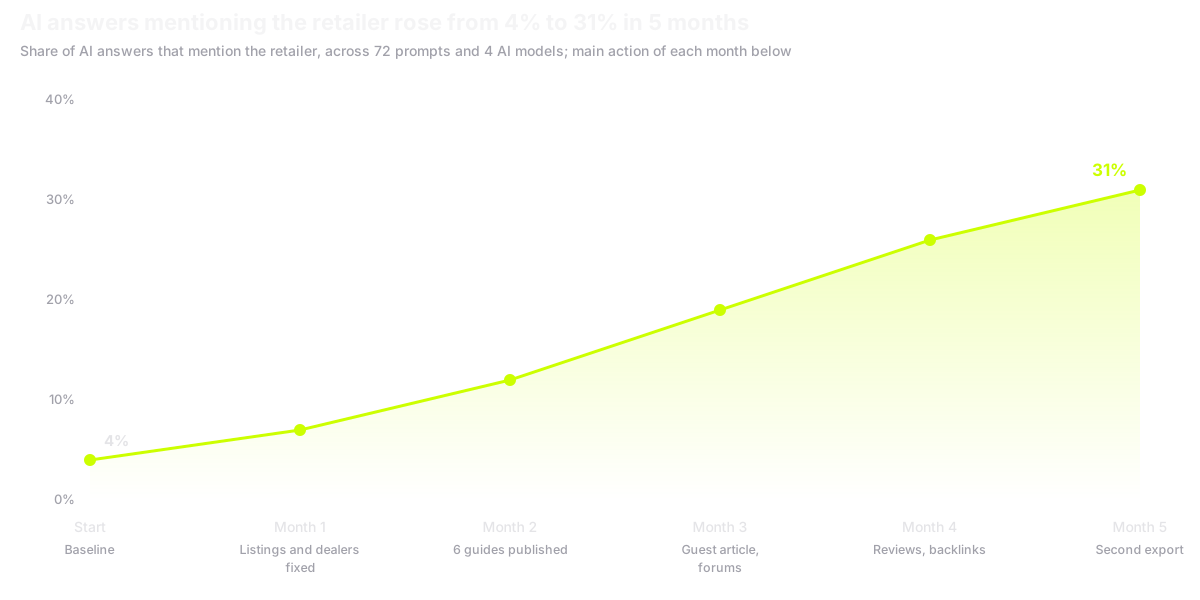
Visibility grew every month, with the biggest jumps after the guides went live and after the guest article and forum work. The AI did not just mention the retailer more often; it described it as a dealer to buy from and a source of advice.
| Measure | Start | After 5 months |
|---|---|---|
| Citations of the client's own website | 11 | 214 |
| Prompts where the client's website is a source | 3 of 72 | 38 of 72 |
| AI models citing the client's website | 1 of 4 | 3 of 4 |
| "Where to buy" prompts mentioning the brand | 0 of 12 | 7 of 12 |
| Monthly website visits from AI tools | ~90 | ~1,450 |
| Monthly quote requests from AI visits | 3 | 41 |
Over the 5 months, 27 new customers came in through AI tools, most of them buying used tractors and combines. For the sales team, the clearest change was in the first call: farmers now arrive saying the AI pointed them to this dealer.
What other retailers can copy
- Start with real customer questions. Your sales and service teams already know the prompts that matter.
- Tag prompts by intent. It shows where you are missing: this retailer's biggest gap was in "where to buy", the questions closest to a sale.
- Wait a few weeks before judging. One run is noise; three weeks shows the pattern.
- Fix listings and directories first. They are fast, cheap and already trusted by the AI.
- Find the deep sources and get inside them. PR, expert quotes and guest articles in the exact publications the AI leans on.
- Make your own site worth citing. Practical guides and clear specs turn a shop into a source.
- Read the context, not just the count. One complaint in a forum can shape how the AI describes you.
- Export, act, export again. Comparing two exports months apart shows exactly what worked.