ChatGPT vs Gemini: How Their Searches Are Alike, How They Differ, and What It Means for Your Brand
Nov 3, 2026 · 6 min read
ChatGPT and Gemini look alike from the outside. You ask a question, the AI searches the web, and you get a written answer with links. But under the surface they search in different places and trust different kinds of websites. That is why a brand can be recommended by one and ignored by the other.
This article explains, in simple terms, what the two have in common, where they differ, and what that means for your visibility.
How both answer with search
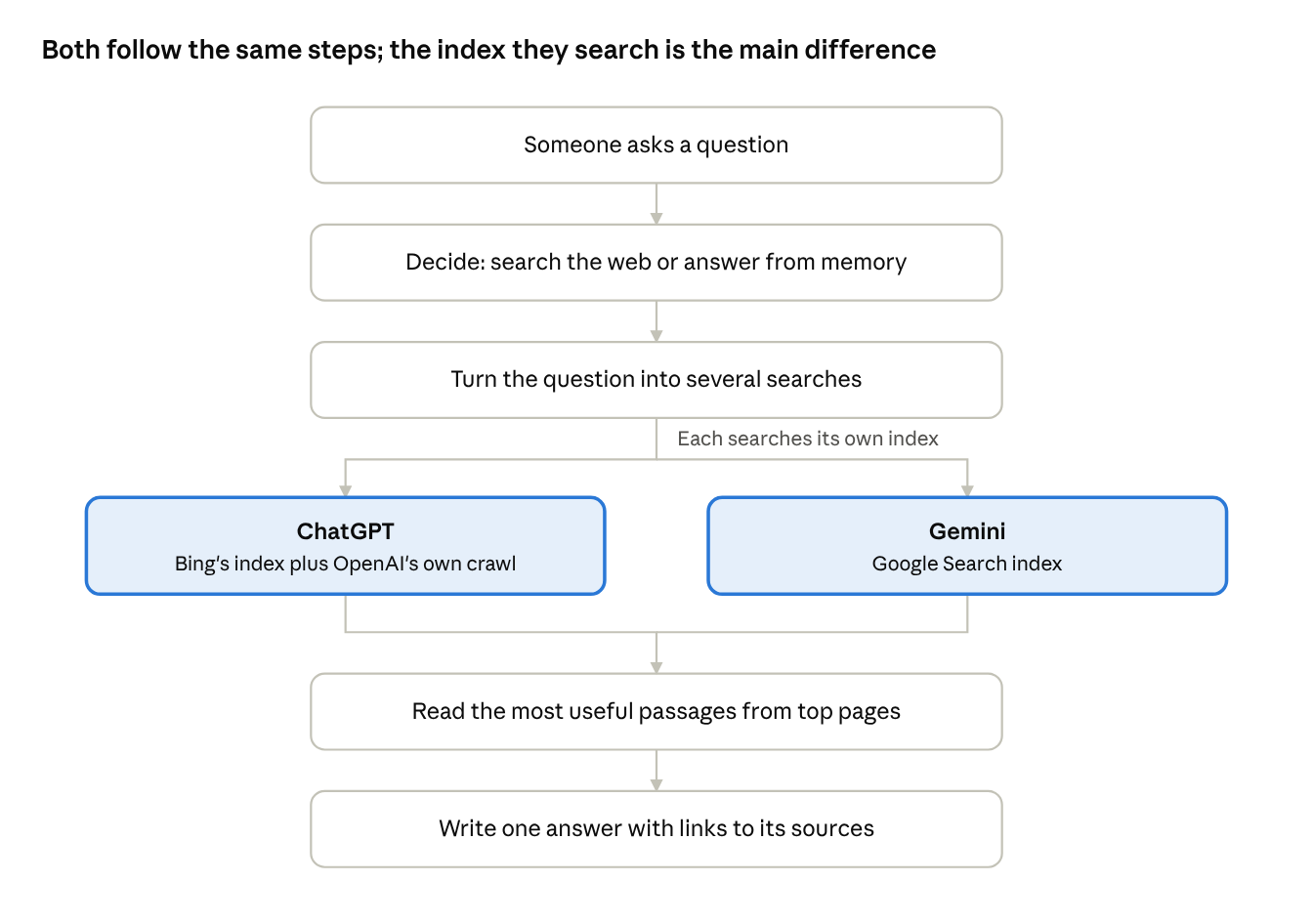
Both tools follow the same basic steps. They first decide whether the question needs fresh information at all. If it does, they turn one question into several smaller searches, look up pages, read the most useful parts and write a single answer with links. The big difference sits in the middle: where they look.
What they have in common
They don't always search. Both decide first whether a question needs live information. A question about a historical fact may be answered from what the model already learned. A question about prices, products or "the best" option usually triggers a search. Google's documentation for Gemini describes exactly this: the model checks whether a Google Search would improve the answer, and only then searches.
They split one question into many. A question like "best running shoes for flat feet" becomes several searches behind the scenes, about running shoes, about flat feet, about reviews. That is why a page can be cited even if it doesn't rank for the exact question someone typed.
They read passages, not whole websites. Both pull short, useful sections from pages. Clear headings, direct answers and facts in plain sentences are easier for both to use.
They show their sources. Both link to the pages they used, so being cited means being seen, and possibly clicked.
They need to find you first. If a page is not in the index a tool searches, it cannot be cited, however good it is.
Where they differ
| ChatGPT | Gemini | |
|---|---|---|
| Where it searches | Bing's index plus OpenAI's own web crawl; OpenAI does not publish the exact mix | Google's Search index |
| How site owners control it | Allow OpenAI's search crawler, OAI-SearchBot, in robots.txt | The Google-Extended setting decides whether content can be used for Gemini's answers; it does not affect normal Google rankings |
| Link to classic rankings | Close to Bing: one study found most ChatGPT citations match Bing's top results | Uses Google's index, but a top Google ranking does not guarantee a citation |
| Favourite kind of source | A wide mix of sites, including forums and media | Concentrated on authoritative sites: government, organisations and official brand pages; very little user-generated content |
| How stable the answers are | Changes often: the same prompt can recommend a different top brand from one run to the next | Draws more often on the same trusted sites |
The index is the root of most differences. ChatGPT finds pages mainly through Bing and its own crawler, Gemini through Google. A page that is well indexed in Google but weak in Bing can show up in Gemini and still be missing from ChatGPT, and the other way round.
Gemini is pickier about who it trusts. BrightEdge's research found Gemini leans heavily on institutional sites, with government and non-profit domains making up a large share of its citations and user-generated content almost absent.
ChatGPT spreads its citations wider. In the same research, ChatGPT relied least on its ten most-used sites of all the engines studied. That makes it easier to get into, but harder to stay in.
How much their sources overlap
Not much. Different studies measure overlap in different ways, so the exact number varies, but they agree on the direction:
- BrightEdge found that ChatGPT and Gemini share only about 39% of their top cited sources.
- Wellows, looking at 22.7 million citations from January to June 2026 with a stricter measure, found the ChatGPT and Gemini pair had the lowest overlap of all engines it compared, at about 6%.
- Writesonic concluded that ChatGPT forms its own citation ecosystem, while Gemini sits closer to Perplexity and Google's AI Overviews.
Gemini doesn't even match Google's own AI Mode closely: BrightEdge measured just 27% source overlap between them.
There is one useful twist. The engines agree more on brands than on sources. BrightEdge found brand recommendations overlapped more than the websites behind them. In other words, two tools can recommend the same brand while citing completely different pages to back it up. Being strong on many trusted websites gives you more ways into both.
What this means for your brand
Because the two tools look in different places, one AI visibility plan is not enough. Some work helps both, and some is specific to each.
| Helps both | Mainly for ChatGPT | Mainly for Gemini |
|---|---|---|
| Pages with clear headings and direct answers | Make sure your site is well indexed in Bing, for example with Bing Webmaster Tools | Make sure your site is well indexed in Google, with Google Search Console |
| Being described well on the websites that already rank for your topic | Allow OAI-SearchBot in your robots.txt | Don't block Google-Extended if you want your pages used in Gemini's answers |
| Accurate, up-to-date facts about your products everywhere | Be present across a wide mix of sites, including forums, reviews and media | Earn mentions on authoritative sites and keep your official pages complete and factual |
| Tracking results regularly | Check often: answers change from run to run | Focus on the few trusted sites Gemini returns to again and again |
How to check it in AnswerRank
- Compare models, not just totals. Look at your results for ChatGPT and Gemini separately. A good average can hide a gap in one of them.
- Read the Model column in the Sources report. The icons show which AI tools use each website. A site used only by Gemini needs a different approach from a site used only by ChatGPT.
- Look for sites both tools trust. Websites with both icons are your most efficient targets: one improvement there helps in two places.
- Recheck after changes. ChatGPT moves faster and less predictably, so give it more frequent checks.
A note on change
Both tools change often. OpenAI has not published exactly how ChatGPT mixes Bing with its own index, and each new model version can shift which sources get cited. The figures in this article come from independent studies published in 2026 by BrightEdge, Wellows, Writesonic and Seer Interactive, and from Google's own Gemini documentation. Treat them as a picture of the current pattern, not a fixed rule, and use your own AnswerRank data to see how the two tools treat your brand today.